- Date
- April 18, 2023, 18:20 local (22:20 UTC)
- Place
- London, OH
- Injuries
- 2 fatal
- Damage
- Substantial damage
- Phase of flight
- Approach
- Aircraft
- N734GBCessna 172
- Defining event
- Approach-VFR pattern final: Loss of control in flight
- Weather
- Visual (VMC) · Day
- Status
- Completed
- Report
- Approved by Office Director
- Investigation class
- Class 3
- NTSB office
- Eastern Region Aviation
- Parties
- Textron Aviation, Lycoming, FAA
- FAA report
- 20230418009829A
- Case key
- 107083
From the NTSB’s public API. By law, NTSB reports can’t be used as evidence in lawsuits over the accident.
On this page
Probable cause
The flight instructor’s failure to maintain adequate airspeed and his exceedance of the airplane’s critical angle of attack, which resulted in an aerodynamic stall at an altitude too low for recovery.
Findings · 3
NTSB’s coded findings. Those marked are part of the probable cause; the rest are factors or other findings. Under each, the cases with the same finding.
Sequence of events
The events NTSB coded, in order, by phase of flight. The defining event is the one that best describes the accident. Under each, the cases with the same event anywhere in their sequence.
Analysis
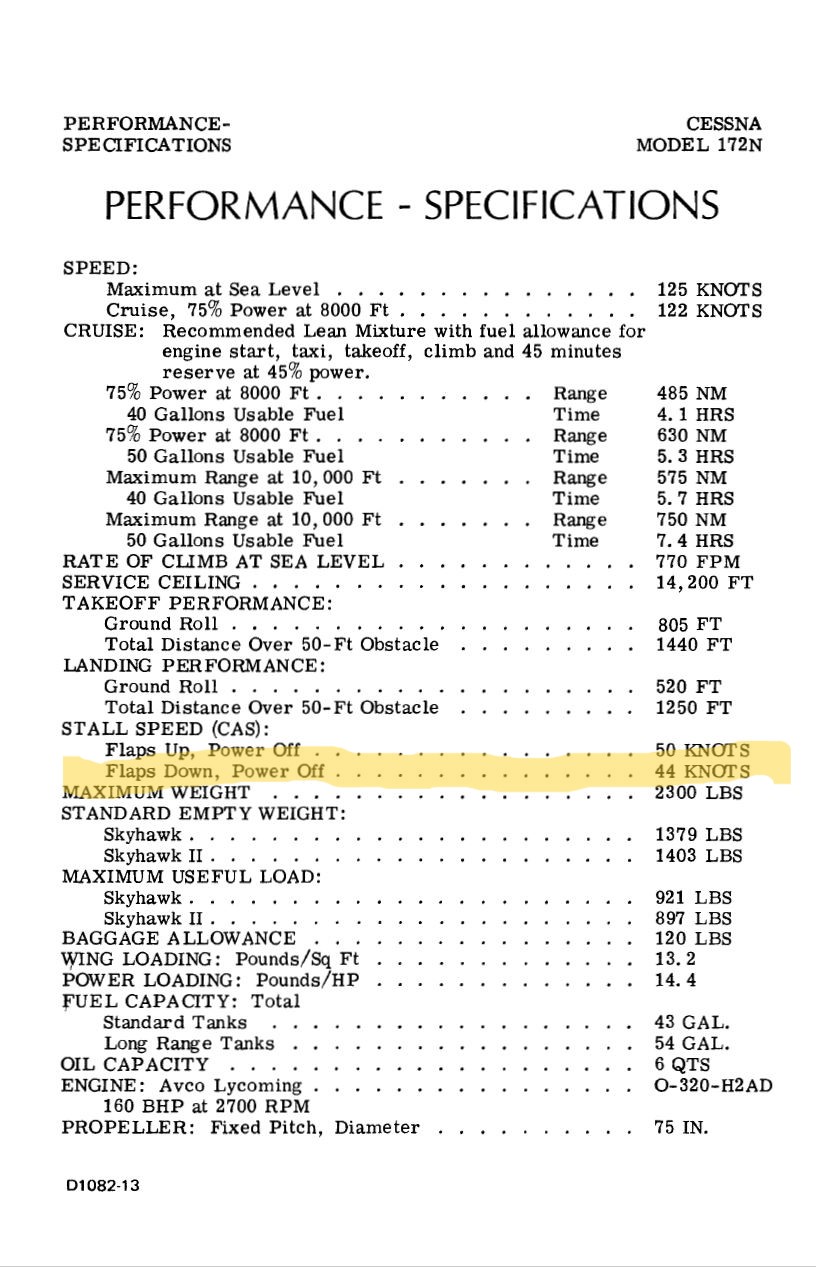
The accident occurred during what was likely the student pilot’s first instructional flight. According to ADS-B data, the airplane was on final approach to the runway for landing in gusty wind conditions, when the accident occurred. The airplane’s calculated airspeed during the final approach was decelerating, and about 150 ft from the runway threshold, it was about 18 knots above its published stall speed given its configuration. The airplane subsequently impacted the ground about 1 ft from the edge of the runway in a near-vertical nose-down, left-wing-low attitude and came to rest inverted. Postaccident examination of the airplane revealed that the damage signatures observed on the wreckage were consistent with a relatively low energy impact, with the majority of the damage being to the forward portion of the airframe. The engine and propeller were compressed aft and up into the fuselage. The flaps were found extended to the 40° position. No evidence of any preimpact mechanical malfunctions or failures were identified that would have precluded normal operation of the airplane. The observed impact signatures were indicative of the airplane encountering an aerodynamic stall at low altitude. Postaccident toxicological testing showed that the student pilot had used the antidepressant medication venlafaxine. This medication and some conditions it may be used to treat have some potential to impair performance. However, considering the accident circumstances, including the student pilot’s limited baseline piloting skill and experience, his limited flight safety responsibilities on the first instructional flight, and the presence of the qualified flight instructor, it is unlikely that the student pilot’s venlafaxine use, or any associated underlying condition, contributed to the accident. Given the decelerating airspeed trend observed in the recorded data and the impact attitude of the airplane, it is likely that the flight instructor did not ensure that sufficient airspeed was maintained and the airplane’s critical angle of attack was exceeded, which resulted in an aerodynamic stall while on final approach to land.
Factual narrative
On April 18, 2023, at 1820 eastern daylight time, a Cessna 172N, N734GB, was destroyed when it was involved in an accident near London, Ohio. The flight instructor and student pilot were fatally injured. The airplane was operated as a Title 14 Code of Federal Regulations Part 91 instructional flight. According to the airport manager, the flight instructor recently rented three hangars and was in the process of building a flight school with new students. The flight instructor recently moved to Ohio, and brought one airplane with him, which was the accident airplane, and he was going to bring two more from where he moved. The airport manager believed that the accident flight was the student pilot’s first flight. According to ADS-B data, the airplane was decelerating during the final approach to runway 27 at Madison County Airport (UYF), London, Ohio. Specifically, when the airplane was about 500 ft from the runway, its calculated groundspeed was 54 knots, or about 70 knots airspeed when accounting for the prevailing headwind. About 150 ft from the runway, the data indicated the airplane’s calculated groundspeed was 46 knots, or about 62 knots airspeed. According to a pilot operating handbook for the make and model airplane, the stall speed with full flaps extended was 44 knots. The flight instructor’s logbooks were not recovered. According to FAA data, the flight instructor received his flight instructor certification on October 13, 1998. The wreckage was located inverted about 1 ft from the end of runway 27, on a magnetic heading of 270°. The damage correlated with the airplane impacting the terrain in a left-wing-low, nose-down, near-vertical attitude. The impact damage was also primarily concentrated on the forward portion of the airframe. The engine and propeller were compressed aft and up into the fuselage. The instrument panel was fractured in several places and contained no useful information. The lap seat belts were intact; however, the webbing on both shoulder harnesses had come unstitched. The propeller spinner was crushed flat against the propeller. The carburetor was fractured off the engine and found in front of the wreckage about 5 ft away. The nose landing gear remained partially attached. The left wing sustained tapering compression damage near the tip. The left wing tip was separated from the wing. All flight control surfaces remained attached to the airplane. Control cable continuity was established for all flight controls. The elevator trim tab actuator was extended 1.4 inches, which equated to an about 5° tab up (nose down) position. The left flap sustained impact damage and was found in a mid-travel position. The right flap was found extended about 40°. The flap actuator jackscrew measured to be about 5.5 inches, which equated to the flaps being extended 40°. The two-blade metal propeller remained attached to the crankshaft flange via three of the six propeller bolts. The nose cone was compressed around the propeller hub. Oneblade was bent aft about midway. Rotational scoring was noted on the blade bent aft. The second blade remained mostly straight. The engine rotated when force was applied to the crankshaft flange. Thumb compression was established on all four cylinders and valve lift action was observed on each cylinder. Both magnetos were secured to the accessory housing and produced spark at all leads when rotated. The spark plugs were undamaged and displayed normal coloration consistent with normal engine operation. Continuity of the crankshaft to the camshaft was established throughout the engine. The FAA Forensic Sciences Laboratory performed toxicological testing on the both the flight instructor and student pilot. No drugs were detected on the flight instructor. The student pilot detected for venlafaxine. Venlafaxine has a variety of uses for depression, anxiety, and other conditions. Venlafaxine commonly carries a warning that it can cause drowsiness, and that users should not drive, operate heavy machinery, or do other dangerous activities. The FAA considers venlafaxine unacceptable for pilot medical certification.
Aircraft
- Registration
- N734GB
- Reported as
- Cessna 172 (N)
- Category
- Airplane
- Serial number
- 17268833
- Built
- 1977
- Airframe hours
- 7,531.5
- Engine
- Lycoming O-320-E2D, 150 hp, reciprocating
- Damage
- Substantial damage
- Flight
- Instructional · Part 91
- Airworthiness certificate
- Standard, Normal
- Last inspection
- Annual · April 13, 2023
- Airport
- UYF · Madison County, runway 27, 4,000 × 75 ft, asphalt
- Equipment
- Stall warning system, ADS-B
Matched to the registry by N-number and the event date; the registry’s history has gaps, so older matches can be wrong. Compare the reported make and model.
Flight crew · 2
As NTSB recorded them. NTSB leaves out names.
- Role
- Flight instructor
- Age
- 61
- Injuries
- Fatal
- Certificates
- Flight instructor, Commercial, Airline transport
- Airplane ratings
- Multi-engine land, Single-engine land
- Instrument ratings
- Airplane
- Medical
- Class 2, With waivers/limitations
- Seat
- Right
- Restraint
- 3-point
- Toxicology
- Performed
- Flight hours
- 9,890 total
- Role
- Student pilot
- Age
- 44
- Injuries
- Fatal
- Seat
- Left
- Restraint
- 3-point
- Toxicology
- Performed
- Flight hours
- 0 total · 0 in this make and model
Weather
- Conditions
- Visual (VMC) · Day
- Wind
- 280° at 16 knots, gusting 19
- Visibility
- 10 statute miles
- Lowest ceiling
- None
- Temperature
- 57 °F, dew point 21 °F
- Altimeter
- 29.92 inHg
- Observed at
- UYF
- METAR
- KUYF 182235Z AUTO 28016G19KT 10SM CLR 14/M06 A2992 RMK AO2
Docket · 14
The files NTSB released with the investigation on February 20, 2025, on NTSB’s docket system: statements, records, photos and specialists’ reports. 22.6 MB in all.
FAA reports on this event · 1
The FAA’s own accident and incident reports, matched to the aircraft by N-number and date.