The concern sheetPartly OCR
Some pages are OCR from the scanned FAA concern sheet. OCR can misread letters and numbers.
U.S. Department of Transportation
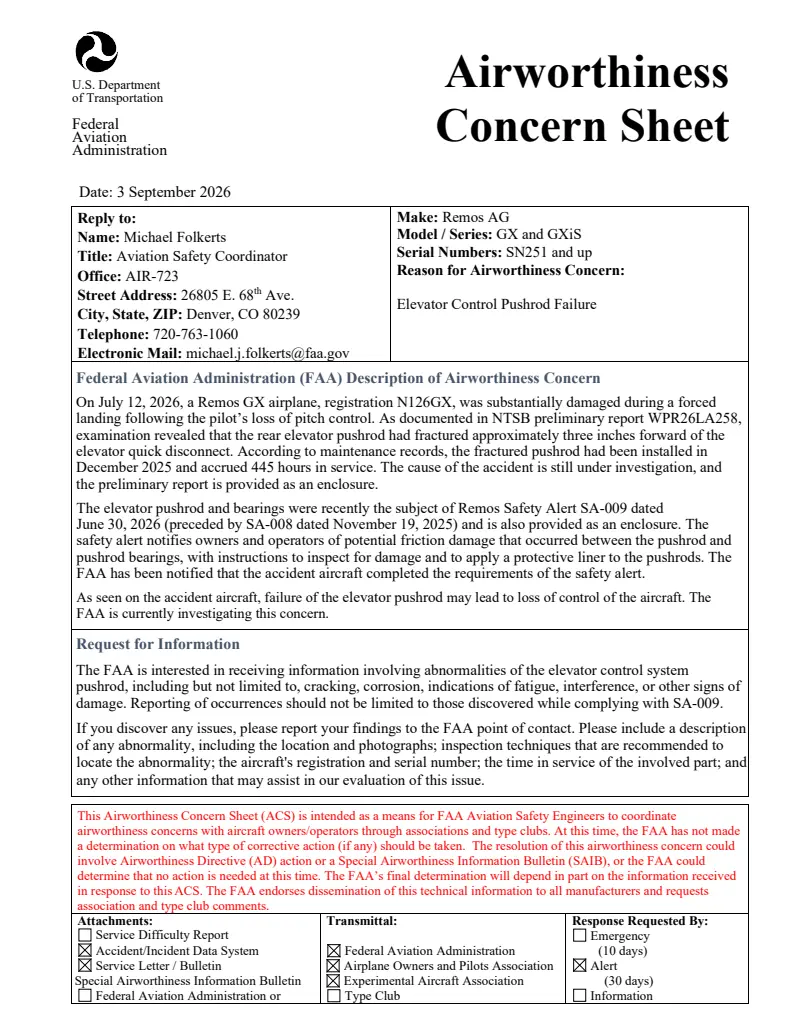
Federal Aviation Administration Airworthiness Concern Sheet Date: 3 September 2026
Reply to:
Name: Michael Folkerts Title: Aviation Safety Coordinator Office: AIR-723 Street Address: 26805 E. 68th Ave.
City, State, ZIP: Denver, CO 80239 Telephone: 720-763-1060 Electronic Mail: michael.j.folkerts@faa.gov Make: Remos AG Model / Series: GX and GXiS Serial Numbers: SN251 and up Reason for Airworthiness Concern:
Elevator Control Pushrod Failure Federal Aviation Administration (FAA) Description of Airworthiness Concern On July 12, 2026, a Remos GX airplane, registration N126GX, was substantially damaged during a forced landing following the pilot’s loss of pitch control. As documented in NTSB preliminary report WPR26LA258, examination revealed that the rear elevator pushrod had fractured approximately three inches forward of the elevator quick disconnect. According to maintenance records, the fractured pushrod had been installed in December 2025 and accrued 445 hours in service. The cause of the accident is still under investigation, and the preliminary report is provided as an enclosure.
The elevator pushrod and bearings were recently the subject of Remos Safety Alert SA-009 dated June 30, 2026 (preceded by SA-008 dated November 19, 2025) and is also provided as an enclosure. The safety alert notifies owners and operators of potential friction damage that occurred between the pushrod and pushrod bearings, with instructions to inspect for damage and to apply a protective liner to the pushrods. The FAA has been notified that the accident aircraft completed the requirements of the safety alert.
As seen on the accident aircraft, failure of the elevator pushrod may lead to loss of control of the aircraft. The FAA is currently investigating this concern.
Request for Information The FAA is interested in receiving information involving abnormalities of the elevator control system pushrod, including but not limited to, cracking, corrosion, indications of fatigue, interference, or other signs of damage. Reporting of occurrences should not be limited to those discovered while complying with SA-009.
If you discover any issues, please report your findings to the FAA point of contact. Please include a description of any abnormality, including the location and photographs; inspection techniques that are recommended to locate the abnormality; the aircraft's registration and serial number; the time in service of the involved part; and any other information that may assist in our evaluation of this issue.
This Airworthiness Concern Sheet (ACS) is intended as a means for FAA Aviation Safety Engineers to coordinate airworthiness concerns with aircraft owners/operators through associations and type clubs. At this time, the FAA has not made a determination on what type of corrective action (if any) should be taken. The resolution of this airworthiness concern could involve Airworthiness Directive (AD) action or a Special Airworthiness Information Bulletin (SAIB), or the FAA could determine that no action is needed at this time. The FAA’s final determination will depend in part on the information received in response to this ACS. The FAA endorses dissemination of this technical information to all manufacturers and requests association and type club comments.
Attachments:
Service Difficulty Report Accident/Incident Data System Service Letter / Bulletin Special Airworthiness Information Bulletin Federal Aviation Administration or Transmittal:
Federal Aviation Administration Airplane Owners and Pilots Association Experimental Aircraft Association Type Club Response Requested By:
Emergency (10 days) Alert (30 days) Information
National Transportation Safety Board Safety Recommendation Airworthiness Directive Alternate Means of Compliance Risk Analysis Type Certificate Holder Other:
(90 days)
AVIATION HIGHWAY MARINE RAILROAD PIPELINE
SAFETY BOARD Aviation Investigation Preliminary Report Location: Glendale, AZ Accident Number: WPR26LA258 Date & Time: July 12, 2026, 10:18 Local Registration: N126GX
REMOS ACFT GMBH Aircraft: FLUGZEUGBAU REMOS GX Injuries: 2 None Flight Conducted Under: Part 91: General aviation - Instructional On July 12, 2026, at 1018 mountain standard time, a Remos GX airplane, N126GX, was substantially damaged when it was involved in an accident near Glendale, Arizona. The flight instructor and student pilot were uninjured. The airplane was operated as a Title 14 Code of Federal Regulations Part 91 instructional flight.
According to the flight instructor, the student pilot was practicing landings at Glendale Regional Airport (GEU), Glendale, Arizona. The student performed a go around and, during the initial climb, he stated that the airplane's pitch control was "delayed." After taking the flight controls the instructor observed that the airplane did not respond to pitch control inputs.
The flight instructor was able to maneuver the airplane using the ailerons, rudder, full nose up pitch trim, and engine power. During the final approach to runway 01, the airplane lost altitude and impacted terrain, resulting in substantial damage to the airplane's fuselage.
Examination of the airplane revealed that the rear elevator control rod had fractured about three inches forward of the elevator quick disconnect. (See figure 1.)
Page 1 of 3 WPR26LA258 This information is preliminary and subject to change.
Elevator Rear Elevator Control Rod Elevator Quick Disconnect Forward Figure 1: The separation in the rear elevator control rod, circled in yellow.
According to maintenance records, the rear elevator control rod had been installed in December 2025 and had accrued 445 hours in service.
The airplane wreckage was retained for further examination.
Aircraft and Owner/Operator Information Aircraft Make: REMOS ACFT GMBH Registration: N126GX
FLUGZEUGBAU Model/Series: REMOS GX Aircraft Category: Airplane Amateur Built:
Operator: On file Operating Certificate(s) None Held:
Operator Designator Code:
Page 2 of 3 WPR26LA258 This information is preliminary and subject to change.
Meteorological Information and Flight Plan Conditions at Accident Site: VMC Condition of Light: Day Observation Facility, Elevation: KGEU,1066 ft msl Observation Time: 10:00 Local Distance from Accident Site: 0 Nautical Miles Temperature/Dew Point: 36°C / 16°C Lowest Cloud Condition: Few Wind Speed/Gusts, Direction: 6 knots / None, 300° Lowest Ceiling: None Visibility: 9 miles Altimeter Setting: 29.9 inches Hg Type of Flight Plan Filed:
Departure Point: Glendale, AZ Destination: Glendale, AZ Wreckage and Impact Information Crew Injuries: 2 None Aircraft Damage: Substantial Passenger Injuries: Aircraft Fire: None Ground Injuries: Aircraft Explosion: None Total Injuries: 2 None Latitude, Longitude: 33.526917,-112.29513 Administrative Information Investigator In Charge (IC): Whitaker, Kathryn Additional Participating Persons: Chuck Baxter; Federal Aviation Administration; Scottsdale, AZ Stefan Maser; Bundesstelle für Flugunfalluntersuchung; Braunschweig Investigation Class: Class 3 Note: The NTSB did not travel to the scene of this accident.
Page 3 of 3 WPR26LA258 This information is preliminary and subject to change.
Safety Alert
SA-009-elevator pushrods page 1 of 10 Copyright Stemme GmbH
Inspection of Elevator Pushrods and Their Bearings
MANDATORY Symbols:
Please pay attention to the following symbols emphasizing particular information throughout this document.
▲ WARNING: Identifies an instruction, which if not followed, may cause serious injury or even death.
█ CAUTION: Denotes an instruction which if not followed, may severely damage the aircraft / engine or could lead to suspension of warranty.
♦ NOTE: Information useful to implement the change more easily.
1. General Issued by: STEMME GmbH, Flugplatzstrasse F2 Nr. 7, 15344 Strausberg, Germany Contact details: web: www.remos.com – email: info@stemme.com – telephone: +49-3973-225519-0 Release date: 30. Jun. 2026 Date of effect: immediately Compliance: At next 100h maintenance or next annual condition inspection, whatever comes firs t.
Release number: SA-009-elevator pushrods Superseded notice: SA-008-elevator pushrods Referenced documents: none Models affected: GX, GXiS
Safety Alert
SA-009-elevator pushrods page 2 of 10 Copyright Stemme GmbH Affected S/N: SN251 and up Reason: An elevator control system with untypically high friction has been found on a REMOS GX. Detailed inspection revealed a damaged bearing of a pushrod of the elevator control system causing damage to that pushrod.
This safety alert provides information on inspecting the control system for safe condition.
Subject: Inspection of elevator pushrods and their bearings and application of a protective liner on the pushrods.
Level of maintenance: heavy ▲ WARNING: As per referenced document: “non -compliance with the instructions could result in further damages, personal injuries or even fatal injuries.”
Weight and Balance: no effect Approval: This safety alert is approved by the aircraft manufacturer i.a.w. ASTM F3198 for conduct on aircraft as defined above. Subsequent to complete and correct conduct of this safety alert, the aircraft will still meet the requirements of the applicable ASTM design and performance specification.
License required: US-LSA ● owner/operator with Sport Pilot Licence (or higher) ● LSA Repairman, or ● A&P Mechanic, or ● Part 145 Repair Station EASA or CAA PtF appropriately rated certifying staff Release to service: After checking without issues the aircraft is released back to service by logging this safety alert with date and signature and license number of the responsible person in the aircraft logs.
In case issues are detected in the inspection described below, release process is Disclaimer This safety alert has been prepared with utmost care. Nevertheless, errors and misunderstandings can never be fully excluded. In case of any doubts the applicant of this safety alert is requested to contact Stemme immediately to clarify the issue.
Safety Alert
SA-009-elevator pushrods page 3 of 10 Copyright Stemme GmbH
2. Change to Superseded Safety Alert
1. REMOS G3-600 has been excluded from the Safety Alert. Only REMOS GX and GXiS are affected. The REMOS G3-600 features a different design of the pushrods and bearings that is not directly comparable to the GX. A separate publication for the G3-600 is currently under consideration.
2. Advise on selection of shrink hose has been added.
Aircraft that have already been inspected and on which the pushrods are either within acceptance criteria or on which the pushrods have been exchanged, do not need to undergo an inspection immediately. Only the recurring actions of section 5 of this safety alert (section 4 in the superseded safety alert SA -008) apply.
3. Resources Workshop Conditions: no specific conditions Parts needed: 3 ea. nylstop nuts M6 G3-8_CS-10-00-05-R02 front pushrod, if so required G3-8_CS-10-00-06-R02 rear pushrod, if so required Material needed: min. 60cm (app. 24 inches) of shrink hose, see section 4.4 for advice Tools: standard tools Special Tools: none Manpower: approximately 4 hours
Safety Alert
SA-009-elevator pushrods page 4 of 10 Copyright Stemme GmbH
4. Instructions
4.1. System Overview
overview of the elevator control system
position of bellcrank assy on ring frame 1 control stick assy front pushrod rear pushrod front pushrod bearing bellcrank assy
Safety Alert
SA-009-elevator pushrods page 5 of 10 Copyright Stemme GmbH
connection of pushrods on bellcrank assy
connection of front pushrod to stick assembly
connection to rear pushrot connection to front pushrot connection of pushrod to stick assembly
Safety Alert
SA-009-elevator pushrods page 6 of 10 Copyright Stemme GmbH
4.2. Disassembly
1. Park the aircraft, preferably in a hangar and set parking brakes.
2. Take out pilot and copilot seat.
3. Uninstall the center console cover:
a. Peel out the colored cover in the parking valve lever (red or blue color, use a small blade screwdriver), unscrew the Philips head screw underneath the cover and take-off the lever.
b. Two hex bolts are in the front, next to the brake lever.
c. Two more screws fix the cover to the baggage compartment frame.
4. Take out the baggage compartment:
a. Two bolts fix the baggage compartment to the frame behind the seats.
b. Another screw is found half way into the compartment on the left side of the floor to fix the compartment to a bracket in the fuselage.
c. Pull the compartment out after having taken out the three bolts.
5. Uninstall the tailcone:
a. Release the two screws attaching it to the fuselage
b. Disconnect the electric wiring for the taillight (if so equipped).
6. Uninstall stick fairings
a. Take out carpets overing the stick fairings (if so equipped) on both pilot and copilot side
b. Lift the leather bag around the from the stick fairings (both sides)
c. Uninstall the stick fairings (hex screws) on both pilot and copilot side
7. Uninstall the front elevator pushrod:
a. Uninstall connection to autopilot servo (if so equipped).
b. Uninstall the front elevator pushrod from the bellcrank assy.
c. Uninstall pushrod from stick assembly
d. Pull out the pushrod to the rear.
Safety Alert
SA-009-elevator pushrods page 7 of 10 Copyright Stemme GmbH
8. Uninstall the rear elevator pushrod
a. Disconnect the quick connector to the elevator.
b. Uninstall the rear elevator pushrod from the bellcrank assy.
c. Pull out the pushrod from the uninstalled tailcone.
4.3. Inspection
1. Inspect the pushrods:
a. Visual inspection of pushrods, slight marks of abrasion may be visible.
b. Measure abrasion on pushrods. Acceptance criteria are given in section 3.5.
2. Inspect all pushrod bearings (1 for front pushrod, 3 for rear pushrod)
a. Visually inspect bearings using a boroscope , a small camera, etc. Slight marks of abrasion, but no damage may be visible on bearings.
b. Acceptance criteria are given in section 3.5.
4.4. Protection of Pushrods
1. Clean and degrease the pushrods. Then apply min. 15cm (min. 6 inches) of shrink hose on the pushrods on the location of the bearings. The middle of the shrink hose shall be at the location of the bearing with the control system in neutral position.
2. In any case, the shrink hose must be long enough, so the bearings are running on shrink hose in any extreme position of the elevator. Applying the shrink hose on the full length of the pushrod is also acceptable.
Application of the shrink hose slightly increases the diameter of the pushrod. This will lead to slightly increased friction in the control system, but this effect is generally very small. Increased friction can be minimized with following means:
1. Use the smallest diameter of shrink hose that just fits over the pushrod. The nominal diameter of the pushrods is 20mm.
2. Do not use shrink hose with integrated bonding or sealant.
3. Using a higher shrink ratio will result in smaller thickness when shrunk.
4. Use shrink hose with thin wall thickness.
5. Prefer PCV shrink hose with slick surface
Safety Alert
SA-009-elevator pushrods page 8 of 10 Copyright Stemme GmbH
4.5. Acceptance Criteria for Pushrods and Bearings Bearings: The bearings do not take up defined load. They only support the pushrod and prevent buckling. Therefore, the only criterion is that they must be movable.
Signs of abrasion and even cracks in the plastic liner are acceptable.
Pushrods: The pushrods will show abrasion on the location of the bearings
typical abrasion after app. 500h TTAF
high abrasion after app. 5.000h TTAF, measurement required Due to the prevailing tolerances of the pushrods (protruded alu minum tubes), measuring the abrasion is a 2-step procedure.
1. Measure the outer diameter of the pushrod outside the bearing area. Nominal diameter is 20mm.
2. Measure area with abrasion. A max. material removal of 0,1mm is acceptable in any location.
sketch of pushrod cross-section D damage ≥ D nominal - 0,1 mm in any location Dnominal Ddamage Dnominal
Safety Alert
SA-009-elevator pushrods page 9 of 10 Copyright Stemme GmbH
4.6. Reassembly of the Aircraft
1. After inspection and application of shrink hose, reassemble aircraft in reverse sequence.
2. Use new nylstop nuts.
4.7. Repair Instruction of Pushrods The pushrods cannot be repaired and must be replaced.
4.8. Repair Instruction of Bearings Contact Stemme for individual repair instructions.
5. Recurring Actions
1. Inspection of pushrods and bearings must be repeated after any 500h.
2. Follow instructions provided in section 4.
3. Renew shrink hoses as required.
6. Feedback Use the following feedback form to report to Stemme.
Safety Alert
SA-009-elevator pushrods page 10 of 10 Copyright Stemme GmbH Aircraft ID Aircraft Model G3/600 GX S/N _____________ Certification ASTM-LSA EASA PtF other _____________ Kind of Operation private use only flying club TTSN _____________ flight school commercial Owner/Operator Company / DBA _______________________________________________ Name SURNAME _______________________________________________ Address _______________________________________________ ZIP, City _______________________________________________ Country _______________________________________________ email _______________________________________________ Feedback abrasion no yes, in following location(s):
_______________________________ damages no yes, in following location(s):
_______________________________ spare parts needed no yes:
_______________________________ need repair instruction no yes:
__________________ _______________________ ______________________ ______________________ city, date Name SURNAME rating/license no. signature submit to info@stemme.com